
In the high-stakes world of professional gambling, particularly at PAGCOR-licensed venues, understanding the cards in Poker is more than just knowing hearts from diamonds. Poker is a game of incomplete information, where the deck serves as the primary source of data. Whether you are playing Texas Hold’em, Omaha, or Seven-Card Stud, the way you interpret the 52 pieces of cardstock in the deck will determine your long-term profitability.
Many beginners focus solely on their “hole cards,” but elite players view cards in Poker as a puzzle of probabilities. By mastering the composition of the deck and the frequency of certain card combinations, you transform a game of luck into a game of mathematical precision.
The Standard Deck: Anatomy of Cards in Poker
A deep dive into the 52-card deck helps players visualize the remaining possibilities during a live hand.

A standard deck of cards in Poker consists of 52 cards divided into four suits: Spades, Hearts, Diamonds, and Clubs. Each suit contains 13 ranks, ranging from the Deuce up to the Ace. While the suits themselves carry equal weight in most Poker variants, the distribution of these ranks is what creates the “hand strength” that drives the action.
Understanding Suits and Ranks
To identify patterns, one must first recognize the individual value and color of each card in the deck. The 13 ranks of cards in Poker are what define your equity in the pot. While suits like Hearts and Diamonds are aesthetically different, their primary function in games like Texas Hold’em is to facilitate Flushes. Knowing that there are exactly four of every rank and 13 of every suit allows a player to calculate “outs”—the specific cards remaining in the deck that can improve a losing hand into a winning one. This fundamental knowledge is the first step toward advanced card manipulation.
Hand Rankings: The Hierarchy of Cards in Poker
Knowing which hand beats which is the most basic, yet most critical, skill for any aspiring Poker shark.
The hierarchy of cards in Poker is universal across most modern variations. At the top sits the Royal Flush, a sequence of Aces, Kings, Queens, Jacks, and Tens of the same suit. From there, the strength of the cards descends through Straight Flushes, Four of a Kind, Full Houses, and so on.
The Power of High-Value Pairs
While big hands like Flushes are flashy, the majority of pots are won with simpler combinations of cards in Poker. Often, the most dominant cards are high pairs, such as pocket aces or Kings. However, these “monsters” are only as good as the board allows them to be. Memorizing these rankings until they become second nature is essential because, in the heat of a big pot at a PAGCOR table, you cannot afford to second-guess the value of the cards in your hand.
The Concept of Card Counting in Poker
Unlike Blackjack, card counting in Poker is not about tracking high or low cards, but about calculating equity.

When people hear about counting cards in Poker, they often think of Hollywood movies where geniuses track every single card. In Poker, however, card counting is essentially the practice of “counting outs.” This involves looking at the cards in Poker currently visible on the table and determining how many of the unseen cards in the deck will help you win.
Probability and the “Rule of 2 and 4”
Mastering the math behind the deck allows you to make “plus EV” decisions every time it is your turn to act.
To simplify the math of cards in Poker, professional players use the “Rule of 2 and 4.” Once you have counted your outs (the cards that improve your hand), you can estimate your chances of winning. If you are on the flop and waiting for one more card to complete your hand, multiply your outs by 4. If you are on the turn, multiply by 2. This logical approach to the cards is what separates the winners from the losers.
Reading the “Board Texture”
The community cards tell a story; learning to read that story is key to identifying your opponent’s strength.
In games with community cards, the “board texture” refers to how the cards in Poker on the table interact with each other. A “dry” board (e.g., A-7-2 of different suits) offers few draws, meaning the player with the highest pair likely wins. A “wet” or “coordinated” board (e.g., 8-9-J with two spades) means the cards in Poker are likely to have completed Straights or Flushes.
Dry vs. Wet Board Dynamics
The texture of the visible cards in Poker dictates whether you should play aggressively or cautiously. On a dry board, your strong cards are relatively safe. However, on a wet board, even a hand as strong as Three of a Kind can be vulnerable. By analyzing the texture of the cards, you can narrow down the possible hands your opponent might be holding. If a third spade hits the river, and your opponent suddenly bets big, the cards in Poker suggest they may have just completed a Flush.
Psychological Impact of Visible Cards in Poker
The mere appearance of certain cards can induce fear or confidence in your opponents.

Beyond mathematics, the cards in Poker have a massive psychological impact. An Ace appearing on the flop is often called a “scare card.” Even if you don’t have an Ace, betting as if you do can force opponents to fold better hands because of the perceived power of that specific card. Understanding the psychological weight of the cards allows you to manipulate the table dynamic.
Card Dead: How to Handle Poor Cards in Poker
Every player will eventually face a streak of bad luck; how you manage it defines your skill level.
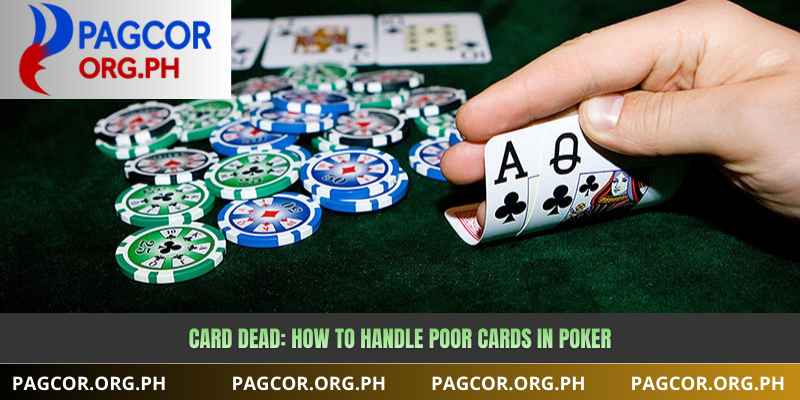
Being “card dead” is a term used when a player receives a long string of unplayable cards in Poker. At a PAGCOR casino, this can be frustrating, leading to “tilt” or reckless play. However, the best players know that even when the cards aren’t going your way, you can still win by playing the “player” instead of the “hand.” Using position and aggression can overcome a lack of good cards.
Ethics and Security: Integrity of Cards in Poker
Maintaining the fairness of the game is paramount at PAGCOR-licensed establishments.
At any reputable house like a PAGCOR-regulated sòng bạc, the integrity of the cards in Poker is protected by strict protocols. Decks are regularly changed, shuffled by high-tech machines, and inspected for “marks” or “nicks.” This ensures that no player has an unfair advantage by identifying cards from the back.
Conclusion
In summary, the cards in Poker are the silent orchestrators of every hand. While you cannot control which cards are dealt, you can absolutely control how you react to them. By mastering hand rankings, understanding board texture, and applying basic probability, you turn the 52 cards from a mystery into a strategic roadmap. Keep practicing at PAGCOR tables, stay focused on the numbers, and let the cards lead you to success.